
The Joe Rooz Show
8-22-26
World Ablaze with George Fontes 8-11-26
Interview with Rhett Palmer
11-14-25
Auto-Generated Transcript
And we are at a crisis point, and I want to welcome you both. You both have MBAs.
Where’s your MBA from? Wharton, that’s pretty impressive. You and Trump. Did you get to meet Trump when you were there? No. Was he there when you were there?
No. Or is he’s older than you? A little bit older. How old are you? I am 74.
Okay, I’m 72 next week. And you went to where? I went to University of Chicago, Booth School. Okay, great. Impressive. And you got your degree in Numbers?
Accounting, yeah. County. Yep, can I finance? And then investments. And then financial planning. Did a lot of work with IMG, did sports figures and so forth. Great. Now, where are you from originally? Originally Cleveland, Ohio. Cleveland, Ohio. Chicago.
But it’s great to have you guys. This is a very, very, this is the big, we’re
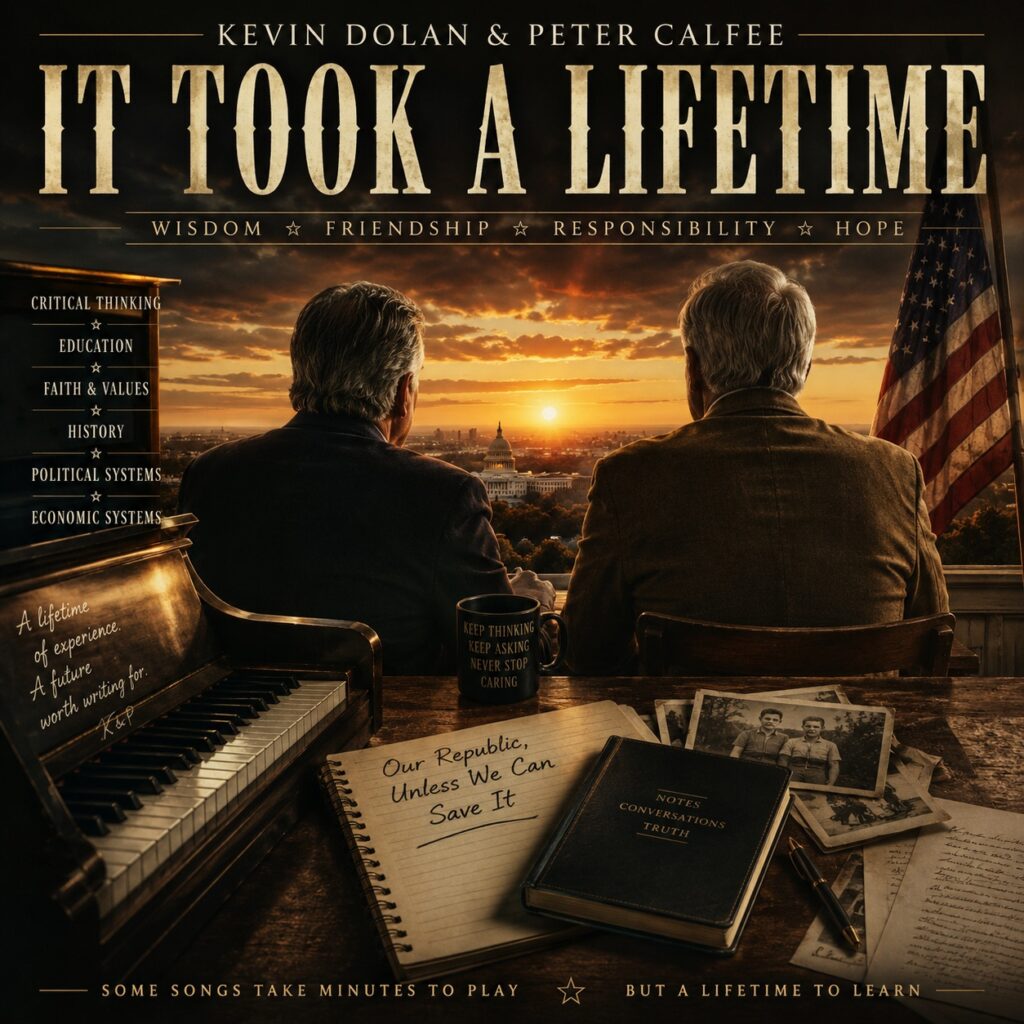
just getting to know each other folks, and I’m glad to have these gentlemen here, and I’m glad they cared enough to do this in the retirement. This is not put not put out, you know, 97 % of all books don’t make any money anyway, but they lead to hopefully speaking engagements. But our country has been hijacked. Okay, so what’s the
genesis of this project? Now we have Peter Coffee, right? Right here. It’s right here. Peter. You’re Peter. And we have Jay Kevin Dolan. Right. And hopefully soon
they’re going to have their own podcast and we’ll help build up this, this, their numbers across the United States, which will lead to hopefully other speaking engagements, give you credibility and open the doors. So you guys are coming out this like a patriotic evangelist. Well, that was your origination. We actually met.
A friend of mine said, let’s go. We’re a member’s over at Quayal Club. So a friend
of mine said, let’s go to the Veterans Day luncheon. We went. Three years ago.
Three years ago. Peter and I sat next to each other. And then from that
conversation evolved, and we said, you know, we ought to write something, and it’s
all about giving back. It wasn’t to be a commercial success. The purpose of writing
a book was identify and create a background and information that help people
construct the logic to hopefully deal with real problems.
And we developed an idea from Kevin that really critical thinking is eliminated from
a national discourse. thinking critically and all. Everybody’s thinking short term,
what’s in it from me. Nobody cares about the Republic. Nobody cares about long term.
And that spread to… I don’t know about nobody, but a lot of the truth. That’s
good point. All good men need to see evil prevail is nothing. Right.
That’s correct. That’s quotes in the book. Who said that? I forget. It doesn’t
really matter. Don’t look it up now. So well, I think. No, sister. But all good
men do to see evil prevail is nothing. So I applaud you for wanting to do this
early in
question. The democracy, you can have the tyranny of the majority because it’s sheer
plurality. In a republic, you put in, the founding fathers were brilliant in putting
in additional provisions that said we can’t get rid of minority interests and we
need to be able to have everybody have a voice so it’s not a flyover country. So
when they went to the electoral college, it gave representation in terms of the
votes or the number of congressmen and senators, you add those up, and that gives
you the number of electors. And in that process, that makes all of the states
somewhat important, especially if there’s close in terms of competition. And so that
Avoiding the tyranny of the majority is a huge issue. People don’t seem to have.
Switzerland is a democracy. 26 cantons. They get together. They all agree in the
majority. We don’t want minarets. Why does it work there? It works there, small,
homogenous. Now, Hitler didn’t invade them because of the mountains, because they’re
in the middle of the mountains. Is that it? Or because everybody was armed? Keep
going. Those two reasons. He needed their ability to transfer funds. They were access
points to Western economies and so forth. All of that put together. But the
mountains, in fact, there were plans if you read the books. There were plans to
give up the flatlands and go into the mountains to survive as a country. The point
we highlight is that it’s a democracy. There isn’t a republic representation. It’s
each canton votes. Plurality, as Kevin says, done. You win. no more minarets.
They had four built. No more minarets decided. No Congress, no Senate, no House, no
Supreme Court. We have a representation government. House, Senate, tricameral,
legislative, judicial. Well, how will we save this republic here? How will we save?
Because this is the subject of the book will hijack. Our republic, our republic,
unless we can save But the chapters kind of lay it out,
but the critical thing is understanding that we’re here for a nanosecond.
It’s next generation is always the most important. As Reagan said, you know,
you’re one generation from complete failure of the Republic of the Republic. So the
key in this entire process, and it has been for the life of the republic is
education. But what is education? Well, it’s the ability to think,
and it’s critical thinking. And so then what are the characteristics and information
that goes into critical thinking? And education is, that’s the basis so that we can
talk about anything. But then there’s value systems. Well, that’s religion, faith, and
values. And then there’s history. Mankind has done things forever. So you look back
and you find out many, many people have had some levels of success and they’ve had
some levels of failure. And it’s understanding all of the success and failure that
allows you to begin thinking about, hey, we’ve got a problem and we want to solve
a problem and we think this might be a good solution. But if you’re not careful,
you’re going to repeat the mistake of the historical stay. And there are eternal
truths that are 4 ,000 years old, 5 ,000, 3 ,000, 1 ,000. There is a continuity of
constancy of things that have worked before that continue to work today. Truth is
not relative. Hence our premise is that education’s been hijacked. We go through the
various periods in the last 100 years of education, how it truly started out. People
would farm in the afternoon, but they go to school in the morning, all the way
through country day, all the way through individual charter schools and education and
its application of critical thinking and leadership and competition in the classroom
to excel, not just the lowest common denominator passes, move them on to the next
class. All of that’s highlighted. You guys are academics. Well, we’re taking critical
thinking applied to education, applied to… I don’t really know what critical
thinking is the concept. So I’m sure there are others that are listening to this
that don’t know. Can you explain as you would to maybe a 12 -year -old? Well, and
in
is saying, no, if I, if we believe in freedom of speech, which is freedom to think
and freedom to question, well, then your freedom to speak, okay? So that’s, oh, very
simply saying, I see what you’re saying. So if you take those things of what the
freedom is all about, then you say, well, how do I speak about something? Well, I
have to have a well -organized thought process, and I have to question things.
And so you don’t take, in science, some people say, like Fauci famously said,
follow the science. Well, what an idiot because he didn’t follow any science in that
statement. It was, it’s, what has occurred in the pandemic was the fact that it
did, is it come proven now that it’s come from the wet labs, you know, in the
back, well, in China. But in a, in a process where we’re, where we’re going in
critical thinking is to say, you can question anything. You need to question it.
If you’re not questioning things, how do we know we’re working towards a correct
process? One of the biggest problems in life is saying, I’m going to solve this
problem. Well, first off, is that the problem? It could be a symptom. You know,
I wish you guys could have an, ultimately, maybe the podcast will leave this, but a
National TV show. Here’s what I say. Can you imagine? Like, for instance, I used to
buy everything on NBC, CBS, ABC, is hook, line, and sinker. Well, these guys,
they’re watching out for me. I can trust journalists. And we used to have
journalists, which has died slowly. Now, of course, a few years ago, I started to
get critical and go, wait a second, they just said all this stuff, and they
punctuated it by punching Trump in the gut. And it was blatant. So I started the
critical thinking that’s what you would say right now what we could do is you have
this great big thing calling critical thinking but somebody else out there who’s a
moderate thinker and maybe they just want to go through life having a happy time
but if you took maybe individual situations and you had we’re going to have a
replay of the evening news last night folks this is what this announcer said this
is how they framed this situation oh and people go I didn’t realize that.
And if you start that off, then they’ll start to cultivate critical thinking.
Exactly. And then we’ll accomplish something. I’ll give an example of that. In the
60s, 70s, 80s, it was eliminated under Clinton. Fred Friendly ran the Department of
Communications. It was the Fred Friendly rule. If you had somebody like Rather or
Kronkite and they would sit and they would give the news, they could not do this,
they could not raise their eyes, they could not smirk. If they did, they immediately
opened up the opposition to come on for similar time and have a competing voice. So
you got the news, just as you described, you believed it. It was factual down to
the last period. After the 1990s, can you believe this guy? I think this interview
is over, please. And that is what you’re getting. You’re getting cable news,
you’re getting all sides. I’m not talking red -blue. All sides are biased. And you
have no ability to judge. Hence, common sense, the system of reasoning, judgment,
causality, how to logically understand the reasoning behind what they said to dissect
it. You know, and you’d be surprised your local garbage collector or car mechanic
people, you might not, they could coat They know. There’s a lot of brilliance out
there. There’s a lot of unrecognized genius. Oh, I… Called common sense. Yeah.
Which is what we patterned the book after Thomas Payne, 1775, four pamphlets,
anonymous, put together, common sense about the Declaration of Independence, about the
Constitution. And we pattern this without footnotes. Look, we’re going to take you
through education, reason, religion, faith, values, history, corrupted as it is in
your interpretation, politics, economics, economics,
to his faithful Liverpool Labor Party and says I’m living up to my promise.
What was that promise, Kear? My promise was I’m going to control and cut energy
costs, your monthly bill. Kier, what is your solution? My solution to everybody and
he’s adamant, he’s pointing his finger, we are going to cap energy bills for
everyone at 300 pounds. How do you do that? And A variety of applause in the
auditorium in Liverpool, and I’m thinking… Because they’re all into the emotions.
Oh, my gosh. You destroy infrastructure. You cannot control it. You cannot cap
energy. Everybody will be allowed energy. That’s the absurdity. That’s what happened
in New York City a few weeks ago. They got this idiot promising we’re going to
have New York City grocery stores. That’s why you have to understand economics, even
at a minimal level, it’s required because people want things. Okay,
I get wanting. People actually do need some things. Okay, that’s even more important.
But in the process, how does it work? The most success in the history of mankind
has been created by what economic system? Capitalism. And as a function of why was
it so successful? Because people are allowed to pursue their self -interest. Capitalism
is the harnessing of the power of pursuit of self -interest. That’s a great phrase.
And the economic system serves at the convenience of the political system.
Another really good phrase, I believe. Those two phrases capture dependency,
interaction, and how the functionality between political and economic systems really
work. And if you grasp those two phrases, now you say, I need to delve further
into this. And that’s when you begin to open up your mind to realize we shouldn’t
be just arbitrarily saying I like something because I heard it like Kirstarmer
saying, I’m going to cap your prices. That’s impossible. Oh, If the prices get so
high that the utility can’t produce a price, they go out of business. Well, guess
what? When they’re out of business, if there’s, if they’re a monopoly and you’re out
of business, there is no energy.
Churchill, Churchill said it perfectly, is that the inherent price of capitalism is
the unequal sharing of blessings. These are facts of human condition. The unequal
sharing of blessings. the inherent virtue of socialism is the equal sharing of
misery. No, yeah, really. It’s fact, and we’re talking socialism in a certain city
in this country. Read the quote again. The quote, inherent vice of capitalism, the
best system that has raised billions out of poverty in this world. The inherent vice
of capitalism is the unequal sharing of blessing, unequal. Charlie Munger, Berkshire
Hathaway, I for inequality to poverty for all. Sounds horrific,
Charlie, please. But this is what he’s saying. The inherent virtue of socialism is
the equal sharing of misery for all. It is. And no one wants poverty for anyone,
but what is the system we’re presented with? Churchill said it about democracy, and
it applies to capitalism. It’s so important what you two are doing. I’m just sitting
here going, okay, how do I help these guys? What can these guys do? You know, and
bringing it down to the low. I mean, what I thought was, well, maybe, you know,
renting a hall, seriously, on weekends, on Saturdays, and inviting,
who do you go for? They may be liberal because of their indoctrination, but if you,
some way you could entice professors to attend on a Saturday morning we will give
you coffee and donuts and then we’ll give you a steak dinner at lunch and get them
in the look we have these think tanks right i have a friend of his son works for
a think tank i don’t know who pays all these things but they got millions of
dollars up there in tallahassee it’s a conservative thing tank so somebody obviously
cares but the writing checks right you guys are probably a couple of the check
writers but now you’ve taken it a step further and i applaud you because you could
be It’s just like people don’t admire Trump. He’s not even accepting his paycheck.
He’s at the end of his life. He knows this is his last hurrah. This is the time
to leave a legacy. And you guys are stepping forward while you still have your wits
about you, you’re young enough and your early retirement to do this. This is so
important. But how do you do it? Well, the biggest thing, like we said,
the seed corner is the children. And interesting, you talked about a method of doing
it. Seed corn are the children. Yes. Seed corn are the children. The children.
And the key is education. That’s what Soros knew. Yeah. That’s why he got out of
it until 30 years ago and decided I’m going to subjectate education, right? Well,
it’s an indoctrination is what he’s going into. Exactly. But the key in educate is
the process of understanding education. This book as a,
in high school a semester or college a semester, it really would fit nicely into a
semester’s course week by week and break it down into that and discuss,
review and read and a seminar setting with teachers get into the meat of what these
chapters are all about. Because if you can educate the kids, they can start thinking
critically. And that means not automatically accepting what a professor says. Yes. Or
an authority figure says. That’s critical. It’s critical. It’s critical.
It’s not a person coming in and say, I’m the professor. I’m really smart. So spit
back what I say and you’ll get a good grade. Well, kids want to go to higher
school. They want to get a master’s degree, a PhD or whatever. Well, when you’re
indoctrinated, but your gray is dependent upon you getting into the next grade,
you’re developing a habit pattern of indoctrination. It’s destructive. It’s destructive.
Right, to think, question, and speak. Yeah. That should be in every educational door
you walk through. Well, it’s the same reason why people stay in abusive
relationships. Well, this is an old comfortable shoe. And you’re going through life
in an old comfortable shoe. Well, I work in the factory and I just haven’t got
time to think about that. And whatever they do, they do. And having no idea the
spin. What you said was very important that capitalism has brought, what was not
Reagan, Winston Churchill has brought billions out of poverty. If you could talk to
impoverished people and say, do you want to escape? Right. The escape route is
capitalism. Only one. Forget socialism, fascism, monarchism, communism.
Like in New York City, it’s like dumb prevails. Well, and that’s the question,
because when you had indoctrinated kids for a generation, and Reagan says that, you
know, freedom in a republic, you know, could be lost within a generation.
Within a generation. If you’ve educated kids in an indoctrinating fashion, so they’re
not really educated, then you’ve got people that are told to think certain ways, and
so they’re raised, I’m going to be told how to think. No. If you accept that,
you’re defining failure. How do we have what we have today that’s working really
well? Creativity. You think that came about without asking any questions? But you’ve
got to start thinking to ask questions. Okay. What amazes me is like,
okay, I could read this in your book, but it sure is a lot more fun having you
two in here. Why, I don’t know, haven’t anybody pull this apart yet. I’m sure
there’s somebody out there who is brilliant. Why do we, why will we spend an hour
in a classroom with a professor? And even though it’s a lot less information,
but some reason we listen better. What is it the human connection? Why do we still
have? I mean, if tell me, if everything was about just knowledge, naked knowledge,
you can get everything you want on Google or on YouTube now. It’s amazing. GROC
for. Yeah, right. But can be organizing. Organization and structure. I think,
you know, education has been a process like going through college and you get hired
out of college, let’s say. one of the criteria is you take a bunch of courses.
Now, on those courses, there’s required courses. Okay, and there could be some useful
required courses. But there were many courses in college that weren’t all that
useful. No. We haven’t even asked the question. I use it every day. Right, right.
We haven’t even asked the question about what do the children need? Yeah. They need
financial planning. They need to know how to checkbooks. You graduate from high
school and college not knowing how to reconcile a checkbook. Exactly, exactly. There’s
certain basic fundamental functions that you have to do. So if you take children and
say, let’s outline what needs to be done, now you,
in an organized structure, which was part of your question, said, why do we do it
this way? Well, we do it twofold one to hopefully pass on good information and have
good dialogue so that it really sticks with the kids because they’re participating
they learn it much better than if they don’t participate so right like reading you
watch a movie you forget it the next day you read a book you invent the characters
and what they look like you’re participating right okay so it’s why you don’t teach
language by just putting a german movie on yeah listen you’ll You’ll learn German
that way.
What are they saying? Now, it may sound simple what I’m saying, though, but, you
know, why? And it’s great. We need to use that. So I see the education system. You
guys got to get in there. And your archaeological son, correct? These are things
that I think about at three in the morning. I sound like I have a boring life.
Well, you’re up then, too? Was that something to do with getting Well, you know,
some people are willing to leap into the abyss and try to explain the nonconformity
in the Grand Canyon, which is hundreds of millions of years disappeared. Oh, the
fossil record and the sedimentary record and sediment, sediment, sediment, sediment,
sediment, sediment, and so forth, sediment. No, there’s 600 million years missing. How
do you explain that one? Yeah. Some will, some won’t. Sedimentation theory about
everything formed through rivers and sediment, and that’s how we build our earth and
so forth and so on. Well, how do you explain that in reconciliation to 100 -foot
trees that could only have been vertically fossilized, vertical in Canada, 50 sites
around the world, could only happen in a matter of hours. A hundred -foot tree was
filled with sediment. How do you explain that way? I’m not challenging your side.
I’m saying there are things to think about it. I saw that documentary where they’re
saying it actually came in, like these things came in sometimes in a day. Right.
These are things totally contrast to what we’ve been thinking. And so that focuses
you on. Hey, maybe go back to reason, judgment, causality, all of these things apply
to critical thinking and let your mind figure out what, why is this not true?
Don’t be a slave. How do you do this? To young people say, do you want to be a
slave to someone else? When you’re just taking hook, line and sinker, what these
people are saying, you don’t know they’re evil or good. You need to learn what’s
critical thinking. Critical thinking is thinking for yourself. I never really use that
term in life, but you guys brought it to me today. Now I get it. Being critical,
being criticizing, thinking for yourself, watching the evening news and go, wait a
second. What they just said there is not plausible. Right. Now I’d like to… Think,
questions, speak. Yes. Think, questions, speak. I’d like to bring it to what I think
in terms of society’s development. And that, one of the fundamentals in my mind is
Rousseau in the social contract. Now, what is, what is Rousseau’s social contract?
Basically, Rousseau said, is my interpretation, is that we enter into a society.
And by accepting participation in the society, we’re also accepting a contract.
That contract says that society has its laws, rules, regulations, and for the
protection of the society that I live under these rules, I will enter into this
contract and be a constructive participant in this society. Well,
now what is the choice? Well, do I want to go over into another geographical area
and play in Darwinism such that the, you know, the most powerful person wins? No,
I want some control. So if I’ve got something, it can’t be taken away from me. I
want to create some things, but I don’t want to fear what other people will do.
Society needs to protect us a bit. Yeah. From ourselves even. Right. And so over
history’s development of man, developed into organizations, communities,
you know, to currently to the nations that we have. But Rousseau wrote this back in
the 1700s, if you understand the social contract,
which I think is a great explanation of the process, you’re making a commitment. And
that commitment says not only do I accept protection, but I accept to live under
those rules and regulations. However, in thinking critically, I may believe that some
of the rules, regulations, laws are not proper. And so, therefore, there are
mechanisms within numerous constitutions, maybe not all if they’re an autocracy, but a
method that we can change that to improve things. So it’s a living organism that
just and modifies, hence a republic, hence declaration independence, hence our
Constitution, hence our Bill of Rights. All of those are changing and respond. The
issue is they don’t respond very well if nobody is thinking critically. But if we
can birth critical thinking into people, we have nothing to fear. Nothing.
No. I mean, you know. It’s respect for your fellow human. Yeah.
And I’ve got a question. You give me a good answer. I learn. I start most of my
phrases when I want to discuss something. So I don’t, I hate committing to being
wrong. So my technique to avoid that as best I can is to start off with saying,
I could be wrong, but. But you decided you weren’t. That’s good. The only time you
were wrong is you weren’t wrong. Yeah, exactly. But what that allows me to do is
present my information, but you never have perfect information. You never have all
the information. If you don’t have all the information, that means if you introduce
something to me now, based after I’ve said what my theory is and my thought process
is, I can change my mind because I could be wrong. But here’s my information.
You introduce some new information. Oh, that causes me to make an adjustment. I
didn’t embarrass myself. I said, I could be wrong. I’m open -minded. So the process
of indoctrination is closing one’s mind. The process of education critical thing is
open one’s mind. You’re not committed to being right. You’re committed to
understanding more. And that is… Ben Carson said it as head of housing.
Love that guy. I interview his wife for a first -bra -in -way interview of
Chamberhouse. He is so brilliant. Oh, my word. And he said that, that, you know,
we’ve been trained to think politicians can solve our problems. But then he said, at
some point, we wake up and recognize the politicians created our problems.
Now, there’s nothing more basic than that. We offloaded our ability to think
critically. Politicians solved my problem. Well, you know why? Oh, well, I voted for
him. Let them take care of it. I just want to go out and go bowling and eat
popcorn in front of it at the movie theater. I just want to enjoy life. And no,
it’s a participatory sport, you know. Unless you can save it. Our republic,
unless we can save it. Everybody’s got a responsibility. Voting is a big
responsibility. But the integrity of the vote is incredible. How a politician can say
you need a ID to come and attend my event, but you don’t need an ID to vote.
The inconsistency is incredible. And I think that one of the useful tests for
critical thinking is litmus tests. One of the questions is, is something consistent?
If it’s not consistent, it’s not good, okay? It’s got to be, it’s got to sustain
itself for a long time. So is it sustainable? Is it consistent? And when you’re
dealing with those concepts, they are good tests to say,
if I have a problem and I’ve identified the real problem and I create a real
solution, the first things I say is, is this sustainable? Does this put the proper
incentive and motivation system in front of our fellow citizens so that without
supervision, they behave properly within society and are beneficial to all of society?
So incentive analysis of incentive and motivation is critical to critical thinking.
Sustainability is a great litmus test question.
Well, and to your point, people listening, car washers, people take the trash,
they do have common sense. They know how it works. And they need to,
at times, step back and say,
I think I’m right on this. But they’re telling me I’m wrong. Well, they’re smarter.
They must be right. I’m wrong. No, not necessarily.
Logic, reasoning, understanding, the common sense that God gave you. Yeah, common
sense is critical. And that needs to be, that needs to be sponsored. The book’s a
great thing. The book’s only 109 pages long, but It’s got appendices.
It’s got appendices. Okay. And the appendices are numbered to match the, number to
match the chapters. Good font. Brief thing. You know, I’ve been in this, this 13
years. There you go. And we hired people to help us. They helped us. We heard
people help it make it a reasonable. This is brilliant the way they did this. Yep.
Somebody knows what they’re doing here because these are things that I’ve told people
over the years, you know, you do the highlighting and you do the very well done.
Now, I have not read this. It’s just handed this to me today, Well, it’s 109
pages, but the appendices are interesting. It’s a different setup. The appendices
aren’t just, you know, here’s reference things. They support chapters. So they’re
numbered by chapter. It’s like if there’s something that to critical thinking, it’s,
which is chapter one, appendices that apply to chapter one are one A, B, C, D.
Chapter 5 or 5 ABCD. some of the chapters actually don’t have any appendices. But
if you read through and read it through quickly at 109 pages, then you go back and
read a chapter and then go look at the appendices that support that and have some
information that you might want to think about, referring to the qualities of the
chapter. Don’t zip through the book. Then it’s going to take a little, take a few
lines and then digest it, chew on it. Yeah, it is. Yeah, it is a little bit of a
slower read, but doing just what you’re saying. But then, utilize the appendices
actually reinforce things quite well. There’s two speeches by Malay from Argentina in
there. And he’s brilliant. I mean, he’s turning around Argentina. I just hope he’s
successful. Argentina was like one of the wealthiest countries in the United States.
100 years ago. And due to Peronism, they ruined, which is socialism.
They ruined the country economically. And that’s all due to socialism.
The politicians say, what do you want? I’ll give you something. Well, when they’re
giving you something, you’re taking it from somebody, and eventually they’re taking it
from you, too. So what people should be saying about the politicians, don’t tell me
what you’re going to give me. Tell me how efficiently you’re going to spend my
money because I want it spent efficiently so you don’t ask for more. As a matter
of fact, you can find that you don’t need as much. So let me ask you this. You
both are dads? Yes. So let me excuse us. How did you two, you two could,
both very successful men, you could have, you could have taken your energies and
directed them inward. We’ve seen how ugly that is. You guys obviously have directed,
now, the reason I bring up the father thing is because I, You know, death to
south. If you’re going to be a good parent, you’ve got to die to south, right? A
thousand deaths. So how did that? I wonder how that happened. I got to get to know
you guys, but how you both managed to do this. This is just so dang important now
at this point of your life. You could be indulging yourself and going fishing or
playing golf. But for me, decades and decades and decades ago, I make it a practice
to get alone, take an hour, take a half hour, take a day, and figure out, why did
I get up this morning? What propelled me to get up? And more importantly, what am
I going to do today? Why am I here? And I’d write out and I’d document why I was
here and the short of it, synthesized reduction was, I’m here to serve. I’m here to
serve. I’m here to serve. I’m here to serve. I’m here to serve. I’m here to
to give back. That’s how I… And it’s a secret. People don’t get it. It’s more
fun to serve. What are the people, you’re choosing to pursue life, liberty,
and happiness. Okay, great. But what is happiness?
Happiness is internally defined. Success is externally defined.
How many times have you had someone say, if you do this, you’re a success. You
ought to do that. That’d be successful. All those other stuff. Well, pursuing any of
those careers, which ones actually are going to make you happy? Well, that’s knowing
yourself. It’s not doing something to please other people. It’s doing anything. But
then if you develop and we’ve all made mistakes, we’ve all sin, we’ve all, you
know, got things that we’re not proud of in our life. But in the process of
developing evolving, if you look into it and you begin to come to grips with
religion and Jesus in our form. There are other forms of religion,
but you then start saying it is serving others. And so this book was an attempt.
We didn’t care whether this is commercially successful or not. In capitalism, if you
do something really good, the market responds, and yeah, you may make some money.
But the art of creativity of what you care about, like an artist, whether it’s an
artist or a musician, other forms of artists, they’re doing something because they
love it. Well, if you love something, then your purpose is to give it to people,
and if the market recognizes it, which is capitalism, then you can get rewards for
it. Well, that’s allowing people having talent to use their talents, but getting
rewarded for it. Now, is the market perfect. Do you take a nation of 350 million
people and say everything’s going to work perfectly? We can cite example after
example of something wasn’t fair. But when you put laws, rules, regulations in place,
you’re trying to address the quantity of people, not an individual. So when one
person feels cheated, you go like, okay, we can improve that. So what do we do to
the system to change that and improve that. So you resolve social contract, you get
involved and try and make some changes. But in the interim, we’re here as an
evolutionary process. So you experienced a problem, but our solution may not be in
place until after you’re gone. But you’ve got to accept that because you’re part of
society. And there’s 350 million people here. How do we make it better? It’s living
and breathing and morphing. It was a great deal of pleasure in writing this over
three years because we got a lot of fun out of it. We were serving a purpose. But
it also crystallized. And it crystallized it. You think of Harry Potter and you
think of rolling and she got turned down 10, 12, 15 times. Over years, she had
nothing. She was living and off the college. She had nothing. She had living off
the dole. Yeah, living off the dole in England. You’re right. And she, but she had
something not, I’m going to be successful perhaps, but enough that she said, I love
this story. I am not changing this story. This is my story about what I think is
important. And she pursued it. And it didn’t matter about here’s a million dollars
or $5 million or whatever. That just came. I think Harry Potter is a $15 billion
in history unto itself. She’s made huge a mess up. $15 billion. I was just reading
about her this very morning. Dyson. He said, Brett, invented that Dyson vacuum
cleaner. He had a concept. He didn’t make it. He was an engineer. He’s having a
nice life. He paid the rent and so forth and so on. And suddenly, he gives
billions to dollars a year away in his foundation throughout England to encourage,
in many respects, primarily, encourage other engineers to come and be taught for
free, educate for free, to do what he’s wanted. Now, he said, That was his
pleasure. He didn’t do it. I’m going to make a fortune off this vacuum and suck up
dirt. He didn’t think that way. You know, so I was up on the Blue Mountain Ridge
Parkway, maybe a few years ago. And back years ago, when we were all younger,
there was some guy made a lot of money in insurance, and it was like they were
all advertising ever come join this insurance company, and they exploded, and I don’t
know if it was multi -level, It has since gone away, but I’m driving on the
parkway. And all of a sudden, I come upon this park, and I pull in the park so
we can, I have an RV at the time, pull over, make sandwiches, you don’t have a,
and this park was, was that guy bought that land and gave it as a park. And I
said, look at that. The only thing left of all that success they had was what he
gave. Because even the Hindus say what is given is gained, what is kept, is lost
forever. Interesting. That’s an interesting phrase. So, in other words, inspiring other
people who are sitting there in the doldrums or they, there’s, you know, a guy
billionaire on the beach I know of from her, from his doctor. And she told me, he
said, said he drinks all day long. Not really. He’s being robbed of the thing he
could go out and give. Right. You know, even the Bible says give unto others and
your light will rise out of the darkness like the new day sun. Yeah, agree. So
anyway, so it’s a nice new beginning with you guys. Gentlemen, anyway, so pick up a
copy of this book. I’m Red Palmer. See you next week.